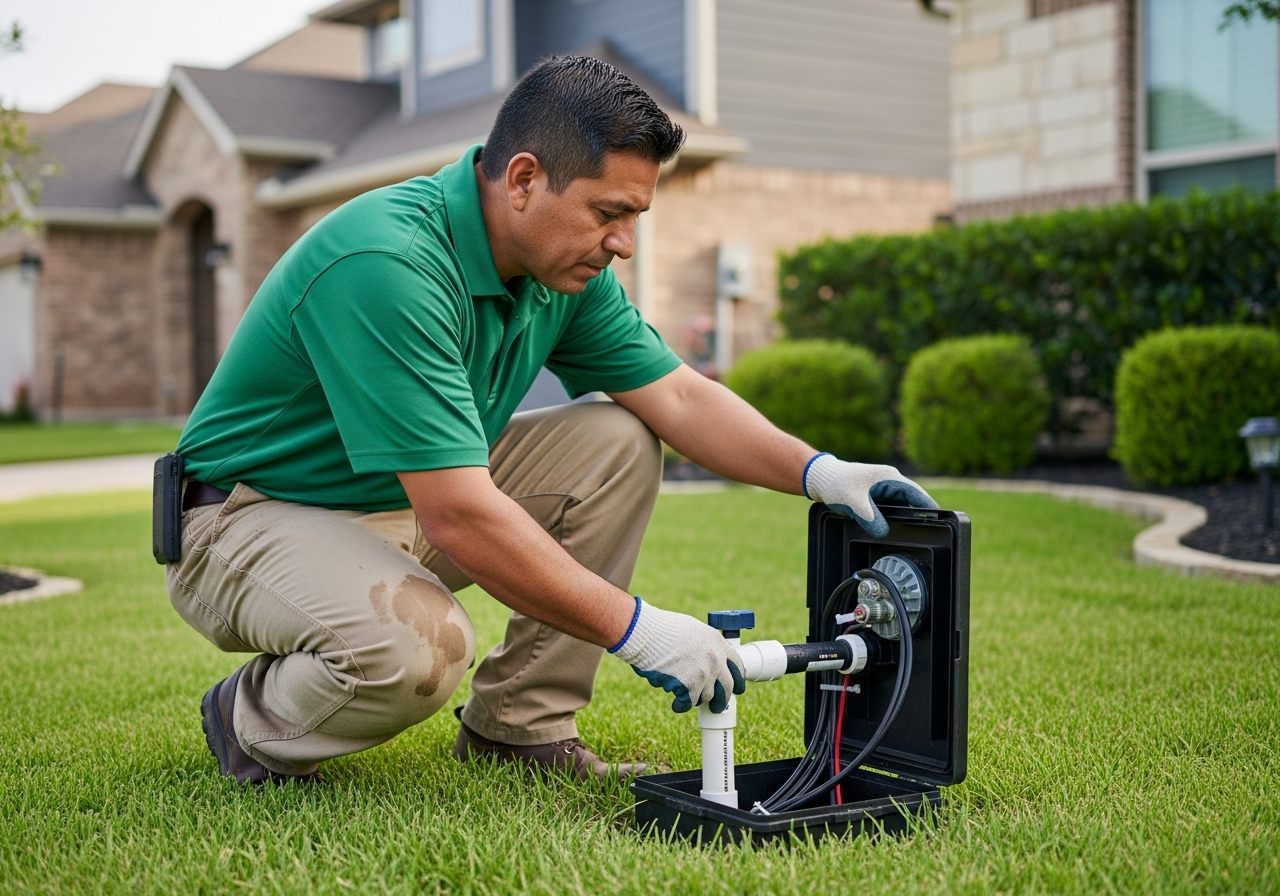
If your home has an irrigation system connected to the city water supply, Texas state law requires an annual backflow preventer test performed by a licensed tester. Most Houston homeowners don't know this until they get a yellow postcard from the city or a shutoff notice in the mail. Our licensed irrigator is also a certified backflow tester — we handle the entire process end to end, from the inspection on your side yard to filing the report with Houston Water.
What a Backflow Preventer Actually Does
A backflow preventer is the single piece of equipment that keeps your lawn's irrigation water from siphoning back into the municipal drinking supply. Every time a city water main has a sudden pressure drop — a fire hydrant opens, a line breaks, a repair crew shuts off a section — the flow direction in a building's service line can temporarily reverse. Without a backflow preventer, the water sitting in your sprinkler pipes (which has been in contact with fertilizer, pesticide, animal waste, and whatever else is on the ground) could get sucked back into the public water system.
Texas Commission on Environmental Quality (TCEQ) rules and Houston Water cross-connection regulations require a backflow assembly on every irrigation system tied to a potable supply. They also require that the device be tested annually by a TCEQ-licensed Backflow Prevention Assembly Tester (BPAT), and that the results be reported to the water authority. Failure to test can result in fines, eventual water service shutoff, and personal liability if a contamination event is traced back to your property.
The three most common assembly types installed on Houston irrigation systems are pressure vacuum breakers (PVBs), double check valve assemblies (DCs or DCVAs), and reduced-pressure-zone assemblies (RPZs). Each one tests differently, fails differently, and carries different costs to repair — which is part of why getting a proper test from a licensed tester matters.
Signs You Need Backflow Service
- You received a compliance notice or reminder postcard from Houston Water
- It has been more than a year since your last test (including if you've never tested it)
- Water is visibly leaking, spitting, or dripping from the top vent of the assembly
- Your PVB is freezing and weeping in winter or spraying water constantly when the system runs
- You just bought the house and have no prior test records
- The device was hit by a lawn crew, a car, or a tree limb
- Water pressure in the system has dropped noticeably since the last time it was tested
Our Backflow Testing Process
A proper backflow test isn't just a visual inspection — it's a calibrated pressure test on each check and relief component inside the assembly, using a gauge traceable to an annual calibration certificate. Here's how we run each test.
- Locate and identify: We verify the device make, model, size, and serial number, and confirm which city and water authority the test will be filed with.
- Shut down the irrigation: We shut off the downstream isolation valve and equalize the system so the test reflects actual valve performance.
- Gauge hookup and calibration check: We connect a five-valve differential gauge to the assembly's test cocks, confirm zero-bias, and record the gauge serial and calibration date on the report.
- Test each check/relief: For a PVB we verify air-inlet opening pressure and the check's forward pressure drop. For a DC we verify each of the two checks. For an RPZ we test both checks plus the relief valve opening pressure.
- Restore service and inspect: We reopen the isolation valve, cycle a zone, and watch the assembly behave under live load to catch any intermittent issues.
- Report and file: The completed test report is signed, dated, and submitted electronically to Houston Water (or the appropriate authority for Katy, Sugar Land, Pearland, etc.), with a copy emailed to you for your records.
What's Included
Every backflow service call covers the full annual testing requirement plus any required follow-up.
- Annual backflow preventer test: Full calibrated test on any device type — PVB, DC, or RPZ — in any size from 3/4" through 2" residential and commercial.
- Official test report documentation: Signed report with BPAT license number, gauge calibration date, and pass/fail results per each check.
- Direct submission to Houston Water: We file the report electronically on your behalf. No printing, scanning, mailing, or chasing down acknowledgment.
- PVB repair and replacement: Bonnet rebuilds, air inlet kits, poppet replacements, and full assembly swaps for Febco 765, Wilkins 720A, and Watts 800 series.
- Double check valve testing and repair: First and second check rebuilds on the common Febco, Wilkins, and Watts DC assemblies.
- Reduced pressure zone assembly service: RPZ rebuilds and replacements for larger residential and commercial systems, including Febco 825Y and Wilkins 975XL.
Brands and Parts We Work With
We service and test every major backflow assembly on the market. On Houston residential irrigation the overwhelming majority are Febco 765 PVBs (1" is most common on sub-1-acre residential), Wilkins 720A PVBs, and Watts 800 series PVBs. On newer construction and some commercial sites we see Febco 860 and Wilkins 950XL double checks. RPZs are more common on commercial properties and some larger estates — usually Febco 825Y or Wilkins 975XL.
Our test gauges are Mid-West 845-5 and Watts TK-99E differential gauges, calibrated annually and traceable to a NIST standard. Our irrigator carries a current TCEQ license and a BPAT certification — both verifiable with the state if you ever want to check.
Backflow Issues Specific to Houston
Houston's climate creates two major backflow headaches. The first is freeze damage. Pressure vacuum breakers sit above-ground on an exposed riser, usually 12 inches above the slab, which means they're the most cold-vulnerable part of the whole irrigation system. Every extended freeze since Winter Storm Uri in February 2021 has produced a wave of cracked PVB bonnets, split air inlets, and frozen-split ball valve handles. We replaced hundreds of these in the spring of 2021 alone. If your PVB has never been winterized or wasn't insulated during the last hard freeze, assume it needs service.
The second is the compliance cycle itself. Houston Water sends reminder notices annually — but they also audit. Residential customers have been surprised to find their service flagged for non-compliance and facing potential shutoff because a test was missed years ago. Commercial and HOA-managed properties are subject to even tighter compliance tracking. Because we file directly with the city, we close out the compliance loop immediately and you can pull the report any time from your email.
Finally, Houston's hard water matters here too. Mineral scale builds up on check poppets and relief seats, eventually causing them to fail the annual test. A device that passed clean last year can easily fail this year — which is why the annual test is required even if nothing "changed" at your house.
Pricing and How We Quote
Our pricing model is simple: we give you a firm, written quote before any work begins, so there are no surprises at the end of the job. Final pricing depends on the device type (PVB, DC, RPZ), the size, whether repairs are needed after the test, and whether the device has suffered freeze or impact damage. If your device passes the test clean, you pay only for the test and filing. If it fails, we quote the specific repair or replacement upfront before we touch a wrench.
Call us for a specific quote based on your device and the current year's compliance requirements. If you can tell us the make and size (it's stamped on the body), we can give you a firm test price over the phone.
Frequently Asked Questions
Is backflow testing actually required by law in Houston?
Yes. Texas Administrative Code Title 30, Chapter 290 requires any irrigation system connected to a public water supply to have a backflow preventer tested at installation and at least annually thereafter by a licensed BPAT. Houston Water enforces this requirement and issues notices annually.
What happens if I don't test my backflow?
Houston Water will typically send a warning notice, then a non-compliance notice with a deadline. If you still don't comply, they can fine you and ultimately disconnect irrigation service or flag your overall account. It's not worth risking over a test that takes about 30 minutes.
Can the landscaper or a plumber do this test?
Only if they hold a TCEQ Backflow Prevention Assembly Tester license. A lot of folks claim to "test" backflows without being licensed, but those reports aren't valid and won't be accepted by Houston Water.
My PVB sprays water when the system runs. Does it still pass?
No. Intermittent venting from the air-inlet is normal for one or two seconds during startup, but continuous spraying means the air-inlet seat is failing and the device won't pass the test. It usually needs a bonnet rebuild or, if the body is cracked, a replacement.
How long does the annual test take?
A typical residential PVB or DC test takes around 20–30 minutes on site. RPZ tests can take a little longer. We file the electronic report the same day.
What if my backflow fails the test?
We quote the repair on the spot. Most PVB rebuilds can be done during the same visit because we stock the common repair kits. If the device is damaged beyond rebuild or outdated, we quote a matched replacement and can usually do it same-day.
Due for Your Annual Backflow Test?
Call to schedule. We'll test, file the report, and if anything fails we'll quote the repair upfront — no surprises.
(832) 786-4444